
What types of ad campaign could you run in an Ad Grant?
How should you use your Ad Grant to promote your nonprofit's website? Here are ideas for campaigns you could run, with real-life examples, plus my recommendations for each.
Some of the recommendations use technical jargon that you likely haven't encountered yet, so don't worry if you don't understand the finer points: read this for inspiration and a broad overview, then come back here later when you know what types of campaign you want to run, and you've learnt how to put these tips into practice.
I'd like you to grasp at this early stage, that you should always think about the end goals of your advertising: the objectives of your nonprofit; the actions that people can take on your website; and how ad campaigns funnel people towards those goals.
Two types of ad campaign are available:
Search campaign: puts ads in Google search results, triggered by keywords that you choose.
Performance Max campaign: puts ads in search results, and optionally also Google Maps. No need to choose keywords; instead you define your ideal audiences.
Brand campaign
You should absolutely run ads for your branded keywords. Brand ads get high Click Through Rate (CTR) and usually high engagement. People searching for the name of your nonprofit are much more likely to engage with the website than people searching for other topics. It's not unusual to find that the brand ads get donations, whilst other ads don't.
For most nonprofits that means creating an ad group with keywords for the brand name. But if there are other words associated with your brand then create separate ad groups for those too: for example, you'd put Salvation Army and Sally Army in separate ad groups. If your nonprofit has changed name, create an ad group for the old name too. You don't need to add keywords for misspellings, but do add keywords such as "brand charity" and "brand UK" if you expect people to search for those.
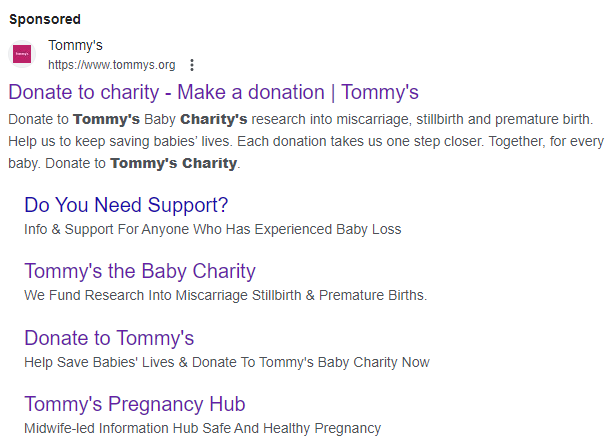
The ad below was triggered by searching for Tommy's brand name. It puts donation asks into the headline, and the descriptions, while also describing what the charity does; and it funnels people to a donation page. But importantly, because we cannot know someone's intention in searching for the brand name, we added sitelink extensions to offer other choices: if someone wants pregnancy information or support rather than to donate, they can choose to visit those website sections instead.
But bear in mind that unfortunate <10% Impression share that Ad Grants are subject to. Most of the times people search for your brand, they won't be shown an ad. If you want to capture all or most of the possible brand traffic, run brand ads in a paid account too.
Since people searching for your nonprofit's name are likelier than the average visitor to take action, you might consider sending them to a landing page for supporters / donors rather than the home page.
Make sure you add business name and business logo extensions at account level, to put your branding on every ad, and to establish trust.
Information provision
This is a type of campaign that the Ad Grant excels at. It's focused very much on the nonprofit's mission. It isn't usually targeting competitive keywords. And it's a great way to get people to interact with the nonprofit for the first time, and build lists. If the topic is of major public interest, the campaign can spend a lot of the monthly budget.
The Tommy's website has a section called PregnancyHub that gives advice about pregnancy and childbirth and baby loss. In Google Ads they have a campaign containing several dozen ad groups, each one focused on a different page. They prioritized the pages that deal with pregnancy complications and risks.
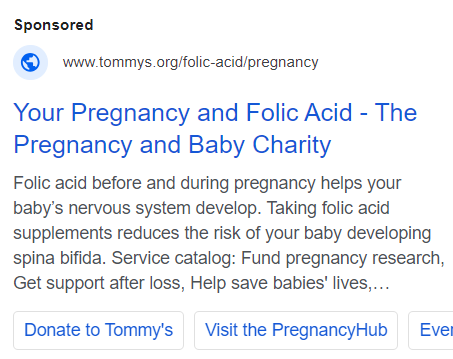
Even if your objective is just to provide information, you should still have Calls To Action on the landing page, and should still track conversions of some kind. For example, Tommy's track newsletter signups, and when people sign petitions. They don't optimize this campaign for a specific goal, preferring to optimize for the default, general account-wide goals.
Google Analytics can be really useful for finding out which pages on your website not just get traffic, but also tend to convert. Create ads for those topics.
Google Search Console is a useful tool for finding out what people who visited your website, actually searched for. You can use it to get great ideas for keywords that are bound to work.
Raising awareness about issues
Similar to an information campaign, but raising awareness of a problem that your nonprofit campaigns about, and usually with a specific action for people to take.
You can choose keywords that are directly about the issue; you might also get results from keywords that are tangential to it. For example someone searching for the topic of miscarriage might be personally interested to learn that the government does not track miscarriage statistics and that is holding back research into preventing baby loss. In that example obviously you would need to be careful about the messaging and relevance.
This type of campaign can overlap with donation, newsletter signup, and petition goals. Once you've made a person aware of a societal injustice or a healthcare failing, they may be primed to support your initiative. Offer multiple Calls to Action on the landing page.
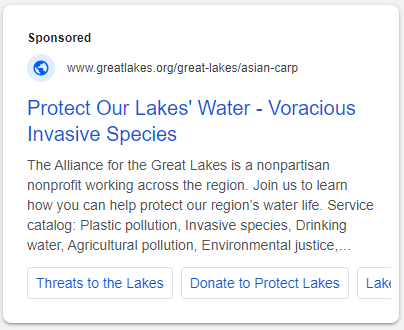
Here's an ad for an environmental nonprofit's campaign to protect the Great Lakes and keep out invasive cap. Their conversion goal is for visitors to click a link to contact their representative in congress with their concerns.
Donation asks
Getting donations is often one of the first things people think of doing when they get their Ad Grant, but unfortunately it's not something that the Ad Grant is well suited for, at least not in isolation. There is too much competition for donation keywords from other grants, and also paid accounts. An Ad Grant is also limited by its <10% Impression share, so is unable to capture all the potential donation traffic, even from your own brand terms.
You need a strategy: a funnel to take people from a first-time visitor, to someone who interacts with the nonprofit, to become a supporter and donor. The Ad Grant's role might be to bring in a large volume of traffic, encourage people to convert by offering signups and petitions, then build your email lists and audiences for remarketing in a paid account.
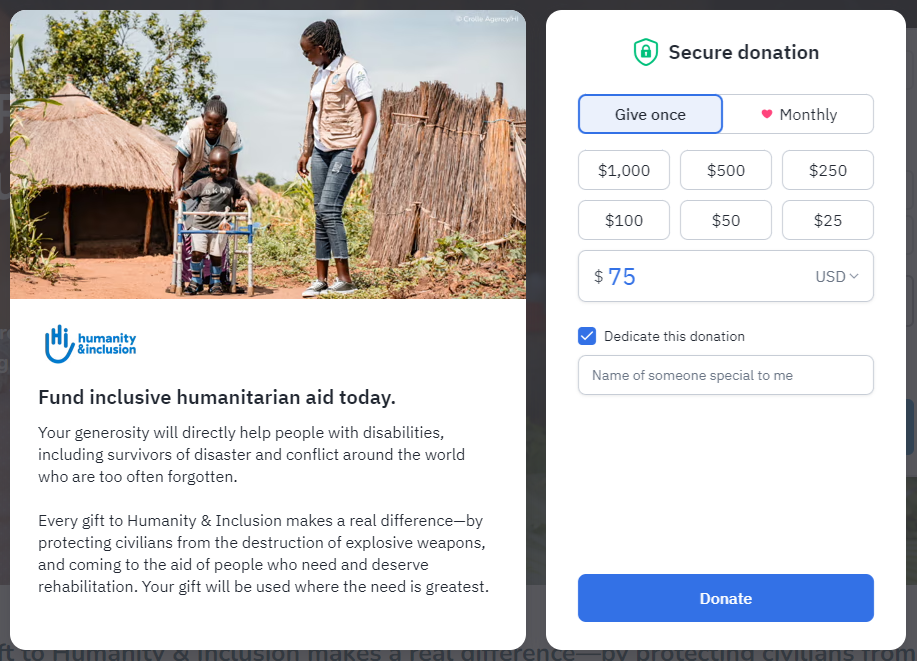
It's more complex than most other types of campaign, reliant on well-written, persuasive landing page text, an efficient and well-integrated donation platform (the screenshot below shows FundraiseUp), and accurate transaction data in Google analytics, as well as a thought-through funnel.
There is a separate lesson in this course to check whether you're ready to take donations.
Recruiting volunteers
If you want to recruit volunteers to clean a local beach, there's no point geo-targeting the entire country. Instead, apply radius targeting to the campaign to reach potential volunteers up to a maximum distance away from the beach. If there are multiple beaches, create multiple radii. It's ok if the circles overlap.
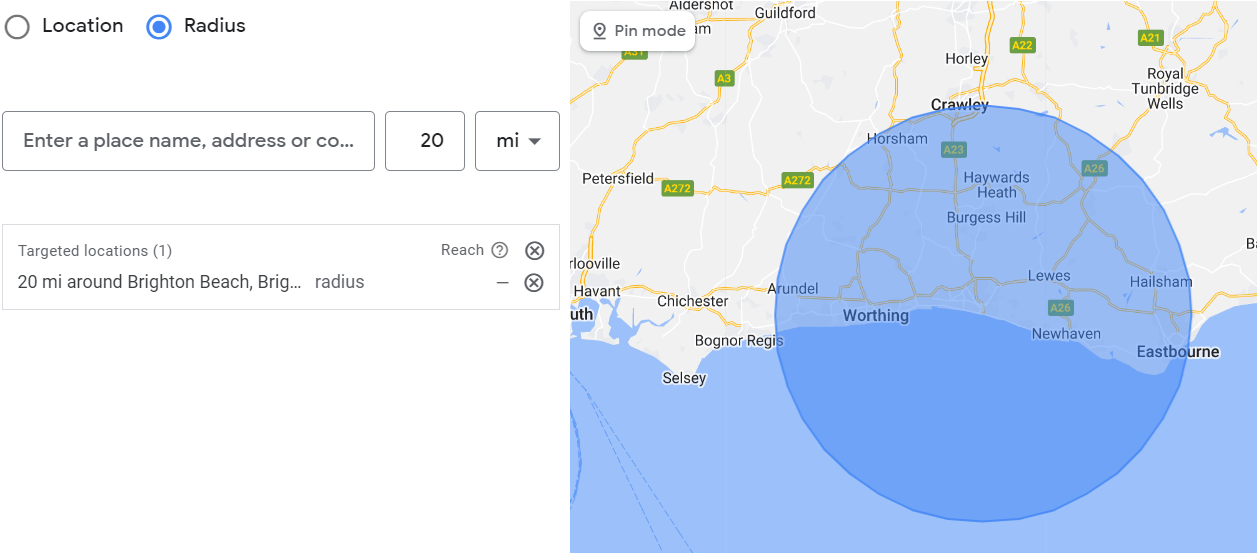
There is a built-in audience called charity donors and volunteers that you could use to optimize your campaign. If you assign it to your campaign, do so in Observation mode for the first few months to gather data; do not switch to Targeting mode until you are certain that the audiences can get enough impressions and perform better than no audience.
This campaign is one of the few instances when it's both allowed and useful to bid on single-word keywords, specifically: volunteering and volunteer. They're on the exemption list. I've seen time and again that those keywords, especially when matched with a fairly limited geographical reach, can work well. Perhaps that's because a lot of people want to volunteer but don't know what opportunities are available until they are offered suggestions.
Make sure that there is a simple volunteer interest / sign-up form on the landing page, and track it being submitted as a conversion in Google Analytics.
Emergency response
If your nonprofit works in humanitarian aid or disaster relief and needs to respond to emergencies quickly, you don't want to have to spend many hours creating ads from scratch. Build a shell campaign: a campaign you create before it's needed, containing the ad groups you're likely to need, a basic ad containing evergreen messaging, and relevant keywords and extensions/assets. Then you pause the campaign.
When disaster strikes, whether it's an earthquake or a war, make a new copy of the entire campaign. Edit the ad to add wording appropriate to the situation and copy it to each ad group, and update the keywords and sitelinks to match the nature of the emergency.
It's important for relief nonprofits to have accurate, reliable conversion tracking for donation revenue. When you launch the campaign, the conversion action should already be there ready to use.
Consider adding a call extension if you take donations by phone. Add a price extension for suggested donation amounts. In case people aren't ready to donate, add sitelink extensions for awareness or petition pages, where they might sign up.
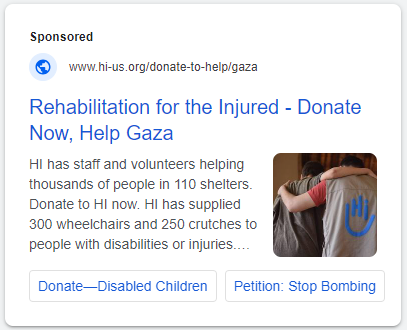
This is one of the most expensive sub-sectors, with high Cost Per Click (CPC) around $10-$12. You'll be up against ads from the Red Cross and other big name nonprofits, so you'll need to run this type of campaign in a paid account to get many donations and a good return on spend. Keep a close eye on search terms for relevance, use a bidding strategy that focuses on return, for example Target ROAS, and be prepared to shift strategy and messaging as the disaster progresses.
Job vacancies
Some of the advice for recruiting volunteers also applies to recruiting staff. Geo-target your campaign relatively locally if these are location-based positions, wider if they are virtual jobs.
Check out any audience targeting that might be useful. There are several built-in audience segments for job seekers, for example people looking for jobs in healthcare.
Take people to a page where they can either apply online, or download a job pack. In Google Analytics you could create a conversion to track file downloads for vacancy PDFs, or form submissions for applications. If you send people to a third party website to apply, the best you can probably do is track outbound clicks to that website as the conversion.
Keep a close eye on the search terms and be prepared to add negative keywords because this type of ad can get a lot of traffic, not necessarily all relevant.
Don't be tempted to choose generic keywords like "charity jobs". That won't work. Choose keywords relevant to the specific job position and the skills needed.
Promote a local service to people in need
Let's take the example of a homeless shelter. You could run an ad campaign targeting a radius from the location of the shelter, using multiple radii if there is more than one location.
Add a location asset so that your ads include a link to your physical locations. To do that you'll need to connect Google Ads to your free Google Business Profile (GBP).
Use several ad headlines and a couple of descriptions to draw attention to the local nature of the service: mention the location, use words like "near" and "local".
Try keywords like "service near" and "local service" and "service in". That's a common way that people phrase their searches for local services. Try keywords that mention the location name.
It's possible that you'd get better results from a well-maintained GBP account than from running a local ad campaign in an Ad Grant, which will always be limited in reach. There are also Local Services Ads, which can only be run in a paid Google Ads account.
Events
If you have frequent events, you might create new ads every month. Or maybe you have an annual conference that you promote far in advance.
Generally there's little point in running short-term ads in an Ad Grant. They're too slow to get momentum and the short time span isn't enough for the machine learning to optimize for results. Start your ads well in advance.
Ideally, track the purchase of tickets or signups as a conversion. That may or may not be possible, depending on the technology you use. If you use a third party ticking system, as many theatres do, check with them that they enable you to connect Google Analytics and collect conversion data.
You can set start and end dates on your event campaigns, so you don't have to remember to switch them off.
If ticket sales are a revenue source, and if the prices are relatively high, consider running event ads in a paid Google Ads account where they can reach more people.
Piggy-back on national and international events
If your nonprofit has a news item on the website where you celebrate a UN day or week, or some other annual event like that, create an ad group for it. Start ads a month or two in advance so they have time to get momentum, and set them to automatically end the day after the event. Next year, update the text, change the year, and run them again. Can often get a good amount of traffic and is useful for bringing new visitors into your orbit. Just make sure the topic is absolutely relevant for your nonprofit.
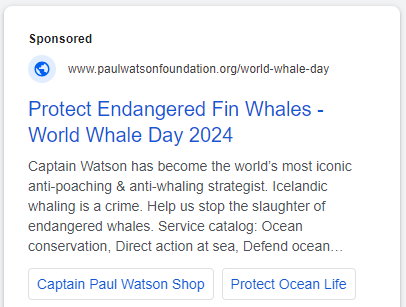
This type of campaign is similar to an awareness campaign in that it works well when coupled with a specific ask: donation, petition, signup etc.
Petitions
Does your website have a petition, with the goal of influencing public policy on an issue? An Ad Grant can be useful for getting those all-important signatures. You should choose keywords that grab people's attention about an issue they care about, perhaps something personal to their life.
The petition should describe the issue and why it matters, outline your nonprofit's stance and demands, and ask for people to put their name down in support. The landing page should state how the petition will be used once completed.
Track the petition form as a conversion, ideally as a form submission in Google Analytics; if it's on a third party website, at least track people clicking to visit that url as a conversion.
What happens after someone submits the petition? Don't waste the opportunity to ask them to take a further action. Ask for a donation. Sign them up for the newsletter so you can email them later with a request for support. That person is primed to support you.
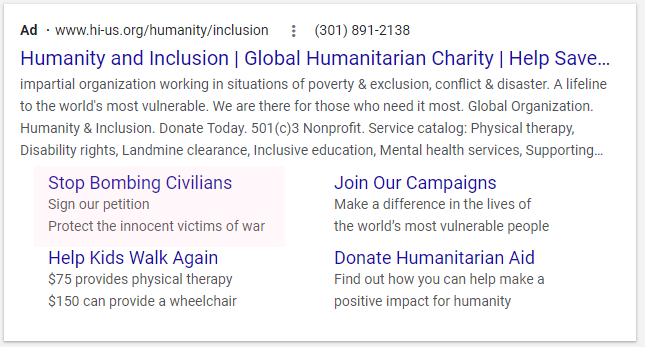
Add a sitelink asset at account level, leading to the petition page, so that people seeing other ads in other campaigns might also see the option to sign it. Here's how a humanitarian aid nonprofit does it:
Sales
Some nonprofits have online shops. Provided e-commerce isn't the main purpose of your website, the Ad Grant rules allow you to advertise products.
You can only promote the products if the shop is published within your own domain, so you can't point ads at Teemill or Shopify urls.
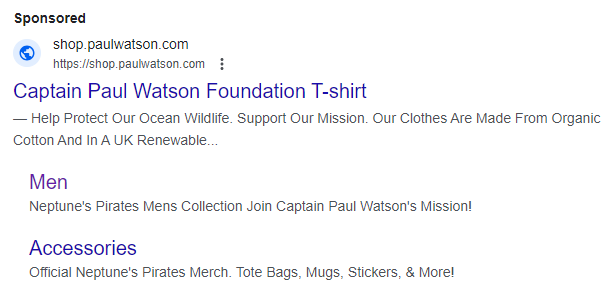
Your shopping cart ought to send transaction data to the monetization report in Google Analytics, then you can use the purchase conversion to power your Google Ads campaign.
Shopping ads are a good example of when you should add sitelink extensions at campaign level relevant to the shop, that might be different to the sitelinks for other ads. For example, for individual products or specific categories of product. You should also add price extensions, and promotion extensions.
Consider running ads in a paid account rather than a grant account, so they can reach more people and compete better. There is even a type of ad called a Shopping ad that you can create in paid but not grant.
Discovery campaign using Dynamic Search Ads (DSA)
There is a separate lesson in this course about how to create DSA ads. They are a type of ad that allows Google, within limits that you set, to promote any page on your website and to write the ads itself.
This technique is especially useful in the early days when you need to get your first impressions and clicks and are still figuring out which keywords will get results. It is a great way to discover what pages on your website Google thinks are worth advertising, and the search terms that people typed into Google to trigger the ads.
When you create a new campaign, especially if you're unsure what people might search for that's relevant, create a DSA ad group with targeting for that section of the website.
Competitor campaign
This is where you bid on competitor nonprofits' brand names to try to direct their traffic to your website. No, don't do it. It's a really bad idea in almost every case. It's an underhand tactic and can backfire.
I know of nonprofits that have been caught out bidding on competitor keywords. One had to return a $1,000 donation intended for another nonprofit; one refused to return a donation given mistakenly to them; and I've seen spats on social media with people sharing screenshots of this happening.
There is an Ad Grant rule against doing this, but I couldn't locate where it's currently written down.
Seasonal campaigns
End Of Year is the obvious example of a short-term seasonal campaign, usually with a defined purpose. Others include the run-up to Mother's Day, Black History Month, and Plastic Free July. If your nonprofit runs summer camps for kids, your seasonal campaign might start well before summer and end once the places are filled.
As with events campaigns, there's barely enough time for machine learning to optimize your ads over time, so start running ads a bit earlier than you'd think necessary.
Use Google Trends to find out when public interest starts and ends for your keywords, to help you decide when to run ads. View the graph over the last 5 years and see if there's a pattern. For example, interest in Black History Month in the US is predictable: it rises from mid January and falls sharply from mid February each year.
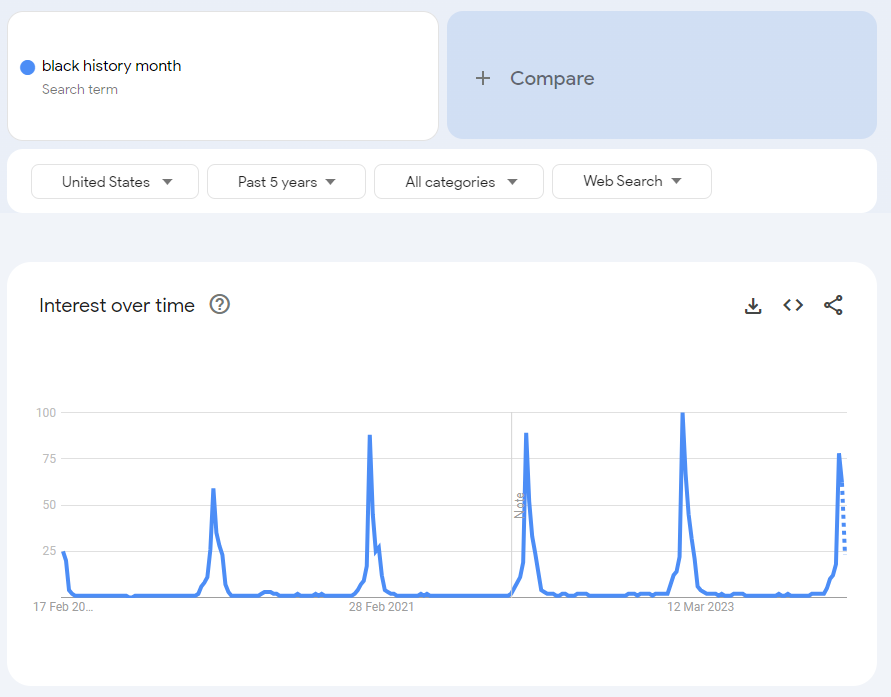
When evaluating success, compare this year's with last year's stats.
Remarketing
This is a type of campaign that puts your ads in front of people who have previously interacted online with your nonprofit, for example by visiting your website or watching a video on your YouTube channel. It doesn't tend to work well in an Ad Grant because the limited audience numbers combined with the <10% Impression share, means that there's too few a pool of people searching for specific keywords.
However, it's a valuable technique in a Paid account, which works well in combination with broader campaigns in an Ad Grant. There will be a separate lesson in this course about remarketing and audience targeting.
13 comments